
In drug discovery research, FASTA and SMILES are two widely used formats for representing molecular data. They play an essential role in computational chemistry, bioinformatics, and cheminformatics, and they are frequently used in drug discovery pipelines for tasks such as molecular modeling, virtual screening, target identification, and structural analysis. Below is an explanation of how to work with these formats in the context of drug discovery research:
1. FASTA Format (Biological Sequences)
The FASTA format is primarily used to represent biological sequences such as DNA, RNA, and protein sequences. In drug discovery, it is mainly used when working with protein targets, nucleic acids, or other biomolecular sequences for various bioinformatics applications, such as protein structure prediction or sequence alignment.
How to Work with FASTA in Drug Discovery:
- Target Identification:
- Gene and protein sequence databases (such as GenBank, UniProt, or RefSeq) provide biological sequences in FASTA format, which can be analyzed to identify druggable targets.
- You can use these sequences to predict possible binding sites for small molecules, protein-protein interactions, or perform sequence alignments to compare homologous proteins.
- Sequence Alignments and Homology Modeling:
- You can use BLAST (Basic Local Alignment Search Tool) or similar tools to align sequences in FASTA format against a reference database (e.g., to find similar proteins or homologs). This is critical for target validation.
- Homology modeling can then be used to predict the 3D structure of the protein target based on the aligned sequence, which is crucial for structure-based drug design.
- Bioinformatics Tools:
- BioPython and Biopython’s FASTA parser: Libraries such as BioPython allow you to parse, manipulate, and analyze FASTA files. You can retrieve sequence data, align multiple sequences, or extract specific features.
- BLAST (https://blast.ncbi.nlm.nih.gov/): A widely used tool for comparing FASTA sequences against large databases for functional and evolutionary insights.
- Clustal Omega: For multiple sequence alignment in FASTA format.
Example of FASTA Format:
FASTA is a plain text format consisting of a description line (starting with >), followed by the sequence in single-letter codes.
>sp|P12345|PROT_HUMAN Example Protein (Homo sapiens)
MKTAYIAKQRQISFVKSHFSKVLQLMFAEKLNVDLQGVGKMLKGHYTFIEES
LTFIFASGFD
In this example, the sp|P12345|PROT_HUMAN is the identifier for the protein (which corresponds to the UniProt entry), and the sequence is the protein’s amino acid chain.
2. SMILES Format (Chemical Structures)
The SMILES (Simplified Molecular Input Line Entry System) format is a text-based representation of chemical structures used to describe molecules, which is particularly important in cheminformatics and drug discovery. SMILES allows for the representation of chemical structures in a linear format, making it useful for storing, searching, and analyzing molecular structures.
How to Work with SMILES in Drug Discovery:
- Virtual Screening and Compound Databases:
- SMILES is commonly used to represent small molecule drugs or lead compounds in virtual screening databases like PubChem, ChEMBL, or ZINC. You can use these databases to search for molecules with specific structural features or bioactivity.
- Chemical substructure searching: SMILES allows for substructure searching, so you can search for molecules containing specific functional groups or motifs (e.g., aromatic rings, hydroxyl groups, etc.).
- Chemoinformatics Tools:
- RDKit and Open Babel: Both are widely used libraries for handling SMILES data. They can convert SMILES strings to molecular structures, generate molecular descriptors, perform similarity searches, and prepare data for molecular docking or QSAR (Quantitative Structure-Activity Relationship) modeling.
- Cheminformatics workflows: SMILES is used as input for generating molecular descriptors or fingerprints that can be used for machine learning in drug discovery.
- Structure-Activity Relationship (SAR) Studies:
- SMILES strings can be used in SAR analysis to study how changes in chemical structure affect biological activity. By systematically altering SMILES strings (e.g., by adding or removing functional groups), you can identify structural features that improve or decrease activity.
- Molecular Docking:
- SMILES can be converted into 3D molecular structures using tools like Open Babel or ChemDraw, which can then be used in molecular docking studies to predict how well a drug candidate binds to a target protein.
- Molecular Descriptors and Fingerprints:
- SMILES is a convenient input format for generating molecular descriptors and fingerprints (such as MACCS keys or ECFPs), which are used for clustering molecules, virtual screening, and QSAR modeling.
Example of SMILES Format:
The SMILES representation encodes a chemical structure as a string of characters. Here are a few examples:
- Aspirin:
CC(=O)Oc1ccccc1C(=O)O- This SMILES string represents aspirin, with the two ester functional groups and a benzene ring.
- Caffeine:
CN1C=NC2=C1C(=O)N(C(=O)N2C)C- This SMILES string represents caffeine, encoding a purine structure with methyl groups attached.
3. Working with FASTA and SMILES Together in Drug Discovery:
In modern drug discovery, integrating FASTA and SMILES formats allows for the combination of biological and chemical data, facilitating multidisciplinary approaches like structure-based drug design, bioinformatics, and chemoinformatics. Some ways to work with both formats together include:
- From Protein to Ligand Design:
- First, you use FASTA to obtain the protein sequence and then analyze it to predict 3D structures, potential binding sites, and druggable regions (using tools like Homology Modeling, AlphaFold, or Swiss-Model).
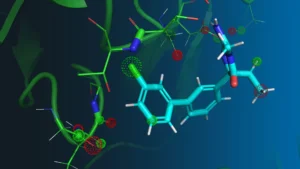
- Once you have a target protein structure, you can use SMILES to represent potential small molecules and design them to fit the binding pocket of the protein using molecular docking (using software like AutoDock or Dock).
- Ligand-Based Drug Design:
- If no protein structure is available, you can use SMILES-based databases for ligand-based design (e.g., virtual screening of small molecules against a target using a receptor-based approach). After identifying hits, you can refine the binding poses and optimize the molecules based on their SMILES representations.
- Biological Data + Chemical Data:
- Tools like ChEMBL or PubChem provide both SMILES strings and biological activity data, enabling you to identify molecules (SMILES) that interact with certain protein targets (FASTA sequences). This allows you to perform large-scale screening for potential drug candidates.
4. Practical Tools and Software for FASTA and SMILES:
Here are some common tools and libraries that can help to work with FASTA and SMILES data:
- Bioinformatics Tools for FASTA:
- Biopython: Python library for bioinformatics, which can handle FASTA sequences and perform tasks like sequence alignment and manipulation.
- Clustal Omega: Tool for multiple sequence alignment (FASTA format).
- BLAST: Sequence comparison tool, often used with FASTA sequences.
- Cheminformatics Tools for SMILES:
- RDKit: Open-source cheminformatics toolkit for working with SMILES strings and performing tasks like molecular structure manipulation, descriptor generation, and molecular docking.
- Open Babel: Open-source chemical toolbox that allows conversion between SMILES and other molecular formats (e.g., PDB, SDF).
- ChemDraw: A commercial tool for drawing chemical structures, which can convert chemical structures to SMILES.
- Integrated Software Platforms:
- PyMOL: Visualization software that can handle both protein structures (from FASTA) and ligand structures (from SMILES) for docking studies.
- Schrödinger Suite: Includes tools for both protein modeling (using FASTA sequences) and ligand modeling (using SMILES) for structure-based drug design.
This content was generated via Generative AI and edited by a human.




Be First to Comment